
How to take constructive criticism

Expansion by Paige Bradley

Expansion by Paige Bradley http://www.paigebradley.com


No matter how amazing you are at your job it is unlikely that you will get through your career without being exposed to some sort of criticism, even if it is just a development need highlighted at appraisal time. I’m not great at taking criticism so this post is as much an advisory for myself as anyone else. There are two main types of criticism, constructive and destructive. Destructive criticism is personal and hurtful, and that is not the type I am writing about here. You don’t have to learn to accept destructive criticism; you have to learn to ignore it. For a harsh but amusing explanation of the difference between destructive and constructive criticism check out this Huff Post blog. With constructive criticism people are generally trying to help you, and whether you think they are right or not, what they have to say is likely to be the vibe they are getting from you so even if you don’t recognise your behaviour in what they are telling you, it is probably worth thinking about the impression you are giving others. Here are some things to think about when you find yourself in that dreaded situation:

Stop your first reaction

Easier said than done right? But at least think about what your usual initial reaction is, because it is almost always irrational. Do you get defensive and start listing all the evidence to prove you are not what the person is telling you? Or do you start blaming other people? Or get angry? Me? I’m a crier. I just can’t help it. I know what people are saying is probably right, and I am usually embarrassed. Recently my line manager took me aside in advance of a meeting a work. I had been asked by a senior director in the company to participate in a working group about something very important to me. My manager warned me that sometimes my passion can make me seem dogmatic and self-righteous, and her advice was to try and communicate in a way that brings people along, rather than turns them off. She was perfectly nice about it, she was trying to help me be more effective, and she was giving me advice rather than just telling me where was going wrong. But, as soon as she said it my eyes started to fill up, and I could feel myself getting hot. This is a sign of embarrassment. A normal, though not professional reaction. My boss could see my reaction and started to feel bad. But I quickly reassured her that she did the right thing; I didn’t want her to feel like she couldn’t give me constructive criticism, I want more of it, it is essential to my development.

Who is the critic?

Just because someone is giving you constructive criticism, it doesn’t necessarily mean they are right, but as I said, you should listen to what everyone has to say because you are making an impression on everyone. But you should think about whether the criticiser’s opinion is important to you, whether they are in a position to know the truth and what their motive is. Most people giving constructive criticism are just trying to help you, even if it may not feel like it. Your boss is hopefully just trying to help you develop, your colleagues are trying to make the team work effectively, and your customers are trying to tell you what you can do to give them better service and make them return. If it is the office busybody or someone who thinks they are more of an expert than they are, then their opinion may have less credibility for you.

What useful information are they giving you?

How good the critic is at delivering criticism will affect how much crap you have to wade through, but really try and think about the underlying meaning. Recently I sent an email out to a big distribution at work. It was trying to get people to do something really boring but necessary, so I used my usual brand of humour to lighten it a little. Well, one person replied to all with an inference that my email was bullying behaviour. I was mortified. Everyone saw it. Many people came to me and said “don’t listen to the guy, we all know he’s an idiot” (see previous point about who the critic is), people emailed my boss saying “anyone who knows Kathryn knows that was a joke, and most people I spoke to told me to ignore it. Except my boss. There she is again, insightful as ever. She said to me along of the lines of “you didn’t do anything wrong, everyone else supports you, but there is a lesson to be learned here and that is that humour doesn’t always come across in email, and just be a bit more mindful about what you write”. Any she was completely right, despite everyone’s support there was something constructive I could learn from the situation, even if it wasn’t the intended message.

You are not supposed to be perfect

This last point is important for maintaining your sanity and self worth. You are not supposed to be perfect. There will always be things that you can improve on, not just you, but everyone around you. Knowing that will make accepting criticism a lot easier. I’m reading Brene Brown’s book The Gifts of Imperfection at the moment and she mentions a line from a Leonard Cohen song, Anthem, which is a useful reminder “There’s a crack in everything. It’s how the light gets in”. Brown says “…our imperfections are not inadequacies; they are reminders that we’re all in this together. Imperfectly, but together.”
Expansion by Paige Bradley

“There’s a crack in everything. It’s how the light gets in” Expansion by Paige Bradley http://www.paigebradley.com



Escaping from Escaping

https://i0.wp.com/upload.wikimedia.org/wikipedia/commons/9/96/Beach_pano.jpg

Why aren’t you working from here instead of in your dull air conditioned office?

The ‘Escape Work Fantasy’ genre is booming business in the world of books, and other media. I read the books with a mixture of envy (why can’t I be running a business from a beach?), scorn at their lack of realism (er, because I have two children, rent to pay and a pension), and finally self-loathing (if I were only more adventurous, dynamic, clever, I’d be an entrepreneur too).

Here are the things I have come to realise:

1. Almost none of the people who give up their jobs to become wildly successful freelancers have young children

2. None of them set up their own business fresh out of stacking shelves at Asda, working as a teaching assistant or admin for the local authority. Almost all of them come from corporate city life with a cushion of money and consultancy skills. This puts paid to the ‘anyone can do it’ fantasy

3. All of the people who give up their day jobs to work 4 hour weeks, or run their business from the Bahamas rely on those of us still working for The Man to live their lives. The person serving them coffee, the flight attendant, the assistant they pay to do the grunt work.

4. Success comes in many forms

Don’t get me wrong, these people have done well for themselves, they are go-getters, most of them have written books to share their knowledge. However, the ‘anyone can do it’ message is unrealistic and yet another stick for us to beat ourselves with, another way in which we have failed. I remember on my first maternity leave feeling genuinely disappointed that I hadn’t started my own kitchen table business, or written a sparkling debut novel about the trials of motherhood.

Even now in my dark moments there whispers a voice that quietly berates me for not having given it all up to pursue an (unspecified) dream, and scorns my lack of risk taking in searching for new jobs when I put that ‘within 50 mile radius’ option in the criteria.

We don’t all have a passion, we don’t all have the entrepreneurial spirit, or the resilience (emotional or financial) to run our own business. For some of us a job is just that, a job. We aren’t saving the world, we aren’t reaching professional heights, we are just getting through the day and looking forward to our next week off. Success and happiness come in all forms, from all areas of our life.

I’m not suggesting that anyone tolerates poor working conditions, or spends the next 10 years in a job that saps their soul. But for those people just muddling along, trying to find their way, sometimes it’s the small changes that count, and that’s where this blog aims to help.

About me sketch

Finding yourself

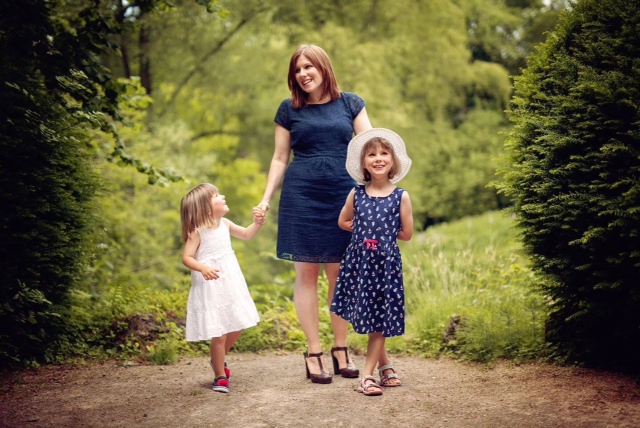
I said I would talk a little bit about myself, and this is one of those posts where I do, but that is because I’m new round here, and I feel like I should tell you a little bit more about myself. I’m a mum of two. Don’t worry, this isn’t a mummy blog (nothing against them, I just presume you’re not here to listen to me witter on about my kids, though you will have to bear with me for a few minutes). I list motherhood first as, there’s no denying it, currently it is the biggest part of my life; even when I am at work, I am a mother to two young girls, and they take up a lot of brain space. Important things that I learned at university, like how to calculate standard deviation, have been permanently overwritten with the theme tune to Fireman Sam. And every coat I own appears to have hair clips and socks in the pocket. Oh go on, since you asked, here’s a picture.

Me and the kids looking gorgeous

©Juno Photography

I have worked for the same company for nearly 10 years, doing various analytical and now staff development roles. I like cake, crochet, and listening to The Archers and tweeting about it on a Sunday morning. Rock on baby.

So, what does that all tell you about me? That I sound like a middle aged woman? But it doesn’t really tell you about the real me. You know when you get those questions “Describe yourself in 3 words?” yeah, I really struggle too.

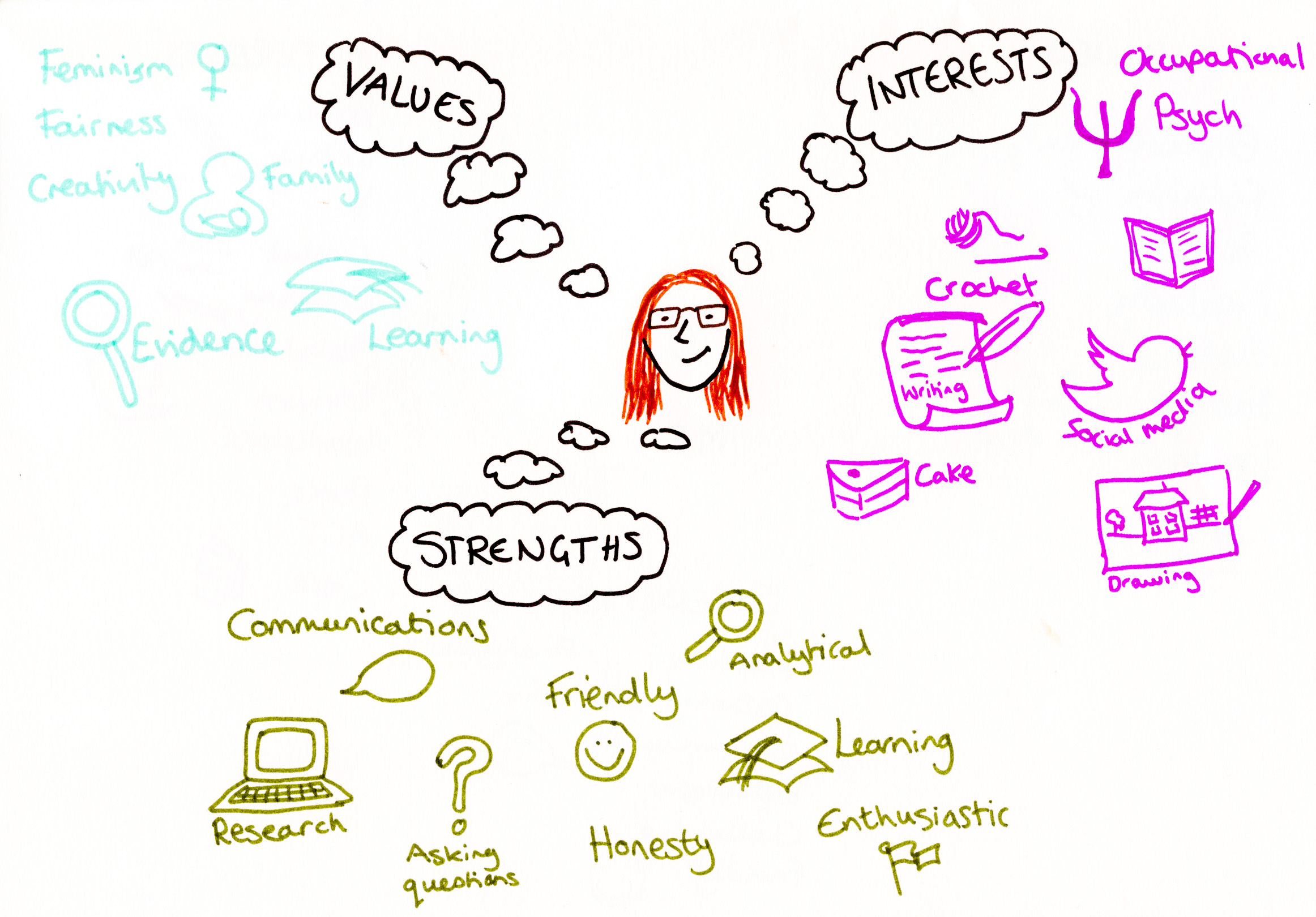
Before I started this blog I sat down and tried to think about what the essentials of me are. My last blog was a testament to my inability to focus on one thing, and that was great and eclectic, but in doing so people who read it for the craft might be put off by the ranty feminism. And those who appreciated my calls for equality might have thought I was betraying the sisterhood with my keenness for crochet and baking. I want this blog to be focused. I want it to be part of my pathway to a future career. I needed to know what I really and truly care about. So I turned to my trusty felt tips and came up with this:

About me sketch

I’m a big fan of visual thinking, and that will come up more in this blog. This doodle or map (or whatever you want to call it) of me helped me to think about what I am really about. Interests is the easiest one. Interests are what you dream about doing when you’re putting the kids to bed. They are the activities you enjoy doing, whether it’s stamp collecting, watching films, or abseiling, we all have interests, whether we indulge them or not.

Values are a bit harder to define. If an interest is what you do, a value is why you do it. There are some great lists and techniques for uncovering your own values which I will blog about in the future.

Finally there are our strengths. I bet for most of you this would be the hardest section to populate, not because it is difficult to define strengths, but because it is hard to identify our own. If interests are things we like to do, and values are why we do things, strengths are how we do them. Again I have more things up my sleeve that can help you identify your strengths.

For now why don’t you give this technique a go? Get yourself some paper and pens, preferably coloured ones (always use coloured pens!) and draw a map of who you are. You don’t have to do it like I did, you don’t have to draw pictures or bubbles, but I will give this one piece of advice, avoiding writing it as a linear list; don’t constrain yourself by the number of lines on a page. Look for patterns and crossovers between the sections, and find out what makes the essence of you.

Scrawly Signature