
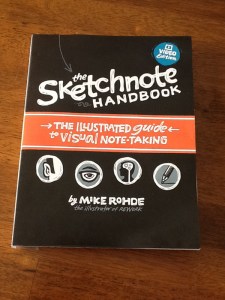
The Sketchnote Handbook by Mike Rohde
sketchnotehandbook.com
I discovered visual note taking late last year thanks to The Sketchnote Handbook by Mike Rohde. I was really taken with the idea of taking notes in images instead of prose. I started giving it a go at work. I’m a confident rather than good artist (as you might see throughout this blog!), but I really enjoy it, and have done since I was younger and used to draw ballerinas from my favourite childhood books. As a psychologist I wanted to know if there was any evidence to the claims the technique makes about helping memory and concentration. But there was no research, the book extrapolates from existing research on dual coding in memory (basically taking things in through more than one modality increases your ability to remember).
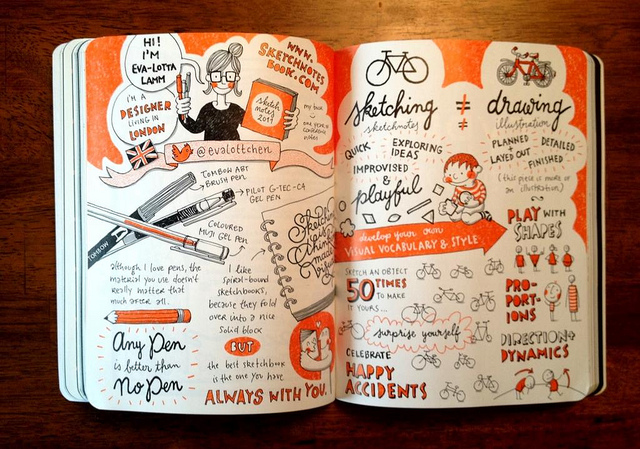
Example of a Sketchnote from The Sketchnote Handbook
So when the time came to decide what to do for my research project for my Masters I cast around for ideas. Should I investigate the impact of back to back meetings on management performance? Well I could, and that would be pretty worthy, but a bit dull. I was going to have to spend nearly a year studying this. So with some some slight reservations from my supervisor I decided to investigate Sketchnoting in the workplace. Except in my dissertation I don’t call it that, I call it ‘visual note taking’.
I taught a group of 10 people at work how to Sketchnote, and then asked them to use it in workplace meetings instead of normal prose note taking. For those of you that way inclined you can read the full report Visual Note Taking MSc. I warn you it’s long. However, I worked really hard on it and am really quite pleased with it. I managed to complete a scientific research project and write up 13k words while working and caring for 2 young kids. I don’t often give myself props but I’m fist bumping myself right now. If you don’t want to read all of it, at least check out the literature review as there is some interesting research in there, especially the papers of Neil Cohn, who writes about how drawing is a skill that must be learned, and isn’t an innate talent, the preserve of the artistic few. However, lack of proper teaching and nurturing of drawing in formative years means that adults grow knowing how to make only rudimentary marks, and lacking in confidence. In fact that is what I found in my research. Sketchnoting is very popular in online communities, especially those who do art and design for a living. For those less accustomed to regular sketching, the visual note taking technique proved challenging, and this affected how useful it was. All the participants really liked the idea of the technique, and could see how it might benefit them, but often their confidence held them back. And the amount of cognitive effort for them to figure what to draw in meetings, or how to draw something, often distracted them from the rest of the meeting. It worked best in passive listening contexts such as large scale briefings or training activities and less so in interactive meetings.
However, several participants expressed a desire to continue to practise the technique, so I am going to set up lunchtime sessions at work.
Visual note taking doesn’t have to be limited to meetings however, it is great for brainstorming activities, both on your own or in teams. Digital drawing is very popular right now, but I am a paper and pen kind of gal. However it would be great not to have to wield a rubber as my ideas change. To the rescue comes the Betabook! The Betabook is a protype product which is basically a white board on the go. Instead of wasting reams of paper, or rubbing pencil lines out (or leaving in changes if you are using pen) with the Betabook you can rub out as you please. The idea is that you can take a photo of the board for the essential notes that you want to keep (and my research found that very few notes are actually essential to keep). The product in on Kickstarter at the moment, and I have just backed it so I can get my very own 1st edition Betabook next spring. I can’t wait!

Jay Cousins, inventor of the Betabook
*Excerpted from The Sketchnote Handbook: the illustrated guide to visual notetaking by Mike Rohde. Copyright © 2013. Used with permission of Pearson Education, Inc. and Peachpit Press.




 Nine to Thrive